Originally from 1987, this modern rerelease features overhauled graphics, audio, and some quality-of-life features in this 2021 “Pixel Remaster” of FF1. As of writing, the underlying game of FINAL FANTASY is the earliest RPG of any form I’ve played. My plan was to continue investigating the origins of some of the fundamental video game RPG systems still utilized today, and as well, I have never played a mainline Final Fantasy game (I believe I rented PS1 Chocobo Racing, don’t believe that counts).
Gameplay
It’s an RPG establishing sub-genre JRPG-defining features I still see today in 2025. I will have to play more games of the era (Dragon Quest, 1986 to start. Will wait for the HD remaster.) to see exactly who started what, but JRPG fundamentals are here in spades. 4-character party, fixed classes for characters. I rolled a Warrior, Monk, White Mage and Black Mage, skipped on Thief and Red Mage. Weapon, Armor, and Magic restrictions to classes. Fixed character art for each class. No non-magic skills that I could discern.
Turn-based combat, attack/item/magic/defend/flee choices, 1 action per character per round, speed + randomness seemed to determine move order. Items are one-time use. The core stat buff/debuff moves/casts still fundamental in RPGs today are present.
Magic seems to roughly follow what I know from Baldur’s Gate 1 as AD&D (D&D 2.0?) rules of roughly a Sorcerer (AD&D was 1977, FF1 was 1987, BG1 was 1998). You have so many casts of a given level of spell, and can know only 3 spells per level. 8 levels each of 2 different schools of magic: white and black. No magic points / mana here- X casts of Level 1 spells, Y of Level 2 spells, and so on.
Gameplay loop centers around advancing story to a new city/town, item restocking, upgrading weapons/armor/magic, running next dungeon, collecting a key items, and an incredible amount of random encounters along the way. The Pixel Remaster lets you to disable these encounters, a massive QoL change from the originals. This, combined with save-anywhere, surely removes a lot of forced risk/reward thinking and difficulty (tedium?) from the original. I definitely did disable random encounters and run back to town a handful of times. Grinding to over-level for the story is easily possible, and I think I unintentionally challenged most bosses slightly over what I should’ve been leveled to. I never party wiped, but did lose a member early on here-and-there. Resurrection is in a town church (DQ11 flashbacks. Is this a JRPG trope I’m discovering?), until magic / items are available.
Fighting trash encounters early on was fun, but quickly gained tedium. High mob-count random encounters with resistances to physical damage felt annoying, as spending magic casts on them felt like a waste. Boss encounters were the most fun and challenging, having to actually use the character toolkits and spells. I didn’t challenge the hidden boss, the “Warmech”, as it seemed hidden behind RNG that could’ve had you trying for an hour for a single attempt- I’m good. Would’ve liked to, though! Hope that RNG for superbosses disappears in the future.
The core gameplay loop seems fundamental to RPG’s today (JRPG’s more specifically). It was clearly innovative for the time, but I’m unsure if FF1 was the trail-blazer for all of these features. I will have to play more games of the era to be sure, but as far as I’m aware, this core format has persevered.
Story & World Building
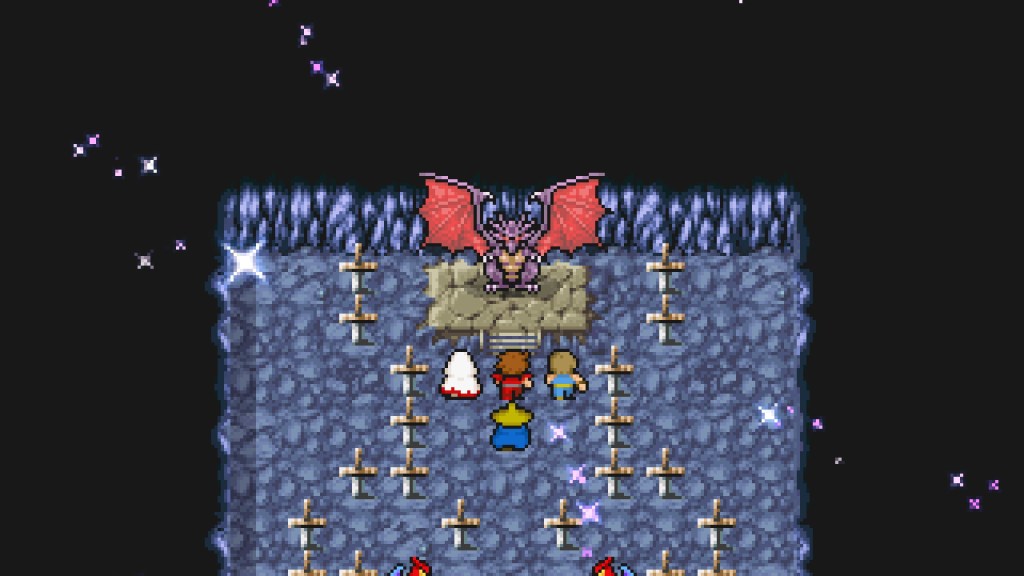
The story is reasonably generic fantasy. Characters aren’t addressed by name, you’re addressed as a group of four heroes saving the world. No personal stories or inter-party interactions here. The mood of the game is presented as a world in turmoil, but it’s hard to see that wandering around, and it clashes with the generally up-beat sound track. The world looks pristine, save for monsters about.
The game establishes/follows game pathing where you follow a linear story path up to a certain point, the story branches into so many (4 gems to power in this case) McGuffins to collect, then comes together to finish the remaining linear path.
You’re forced to talk to every character to find the in-game reason/path to progress, and even then, after a certain point it became difficult to naturally follow the intended path. The game featured a large manual that I believe would’ve assisted in this endeavor. I did consult a fan site after a certain point (after the Crystal of Fire) on a limited basis.
Visuals
Audio
Controls & Interface
Replayability & Length
Final Thoughts
 Evan Logue